
Delhi’s EV Policy : Will we follow China?
The best climate investments rarely sit in the obvious opportunity. They sit in the infrastructure the opportunity eventually demands.
This is a pattern we have seen firsthand at BlueGreen Ventures. Our early investments in Battery Smart (2020) and Varaha (2022) were not bets on EVs or carbon markets, but on the infrastructure constraints those transitions would create into the future.
Battery Smart addressed charging-time constraints as 2W/3W electrification scaled; Varaha addressed the infrastructure gap required for credible carbon markets. Our thesis has consistently been to look beyond the headline transition - to the bottlenecks that become the next investible markets.
Delhi's new EV Policy - effective 1 July 2026 and running through 31 March 2030 is a useful live test of that same logic.
This is a pattern we have seen firsthand at BlueGreen Ventures. Our early investments in Battery Smart (2020) and Varaha (2022) were not bets on EVs or carbon markets, but on the infrastructure constraints those transitions would create into the future.
Battery Smart addressed charging-time constraints as 2W/3W electrification scaled; Varaha addressed the infrastructure gap required for credible carbon markets. Our thesis has consistently been to look beyond the headline transition - to the bottlenecks that become the next investible markets.
Delhi's new EV Policy - effective 1 July 2026 and running through 31 March 2030 is a useful live test of that same logic.
What the policy actually does
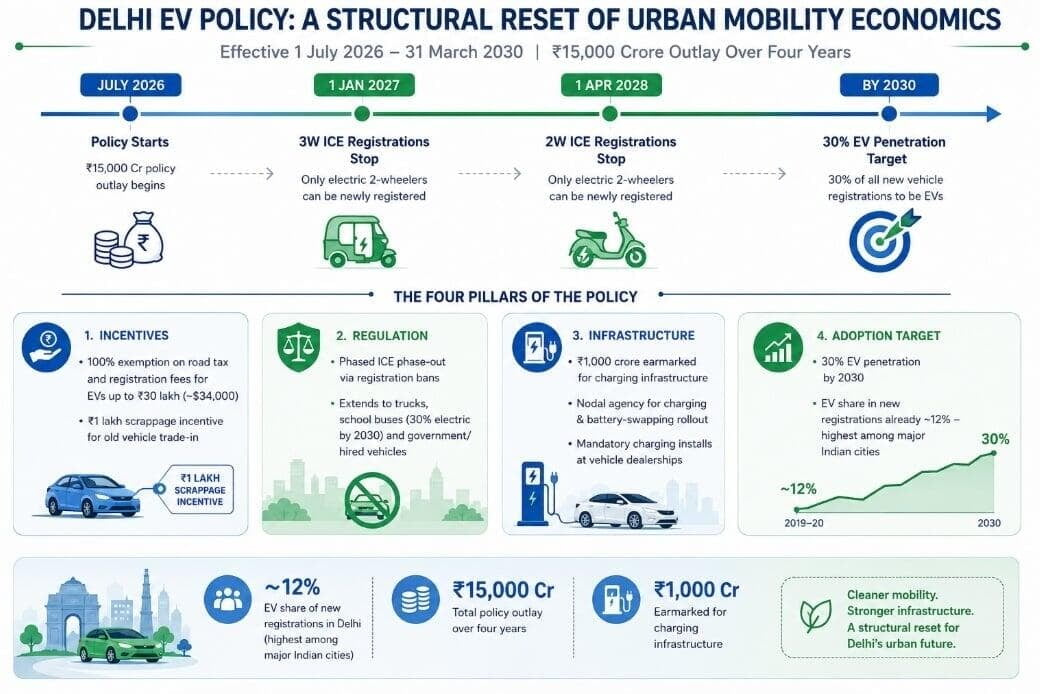
Most coverage of the policy has focused on cleaner mobility and adoption targets. Read through an investor's lens, it is more accurately described as a redesign of the economics of urban mobility, backed by a ₹15,000 crore (roughly $1.7bn) outlay over its four-year term.The core mechanics:
- 100% exemption on road tax and registration fees for electric cars priced up to ₹30 lakh (~$34,000), plus a ₹1 lakh scrappage incentive for buyers who trade in an old vehicle for a new EV.
- A phased ICE phase-out via registration bans - This is the structural departure from earlier EV policies. Only electric three-wheelers can be newly registered in Delhi from 1 January 2027; only electric two-wheelers from 1 April 2028. Similar disincentives extend to trucks, school buses (30% of fleets electric by 2030), and government/hired vehicles.
- Infrastructure mandates alongside the incentives: ₹1,000 crore earmarked for charging infrastructure, a nodal agency appointed for charging and battery-swapping rollout, and mandatory charging installs at vehicle dealerships
- A 30% EV penetration target by 2030, with adoption already running ahead of most other Indian states - Delhi's EV share of new registrations has climbed from single digits in 2019-20 to roughly 12% in recent data, the highest of any large Indian city.
Taken together, this is less an EV subsidy programme and more a structural rewiring of urban mobility economics for one of India's largest vehicle markets, and historically, Delhi's policy choices have tended to set the template other Indian states follow.
The question that matters for investors isn't whether this policy succeeds. It's what becomes the next bottleneck if it does.
Most coverage of the policy has focused on cleaner mobility and adoption targets. Read through an investor's lens, it is more accurately described as a redesign of the economics of urban mobility, backed by a ₹15,000 crore (roughly $1.7bn) outlay over its four-year term.The core mechanics:
- 100% exemption on road tax and registration fees for electric cars priced up to ₹30 lakh (~$34,000), plus a ₹1 lakh scrappage incentive for buyers who trade in an old vehicle for a new EV.
- A phased ICE phase-out via registration bans - This is the structural departure from earlier EV policies. Only electric three-wheelers can be newly registered in Delhi from 1 January 2027; only electric two-wheelers from 1 April 2028. Similar disincentives extend to trucks, school buses (30% of fleets electric by 2030), and government/hired vehicles.
- Infrastructure mandates alongside the incentives: ₹1,000 crore earmarked for charging infrastructure, a nodal agency appointed for charging and battery-swapping rollout, and mandatory charging installs at vehicle dealerships
- A 30% EV penetration target by 2030, with adoption already running ahead of most other Indian states - Delhi's EV share of new registrations has climbed from single digits in 2019-20 to roughly 12% in recent data, the highest of any large Indian city.
Taken together, this is less an EV subsidy programme and more a structural rewiring of urban mobility economics for one of India's largest vehicle markets, and historically, Delhi's policy choices have tended to set the template other Indian states follow.
The question that matters for investors isn't whether this policy succeeds. It's what becomes the next bottleneck if it does.
The China precedent - and where it breaks down
The instinctive comparison is China, which ran the fastest large-scale EV transition on record. The shape of the curve is worth being precise about, because the popular version ("single digits to 60% in a decade") slightly overstates the current position: domestic NEV market share of new vehicle sales was under 5% in 2020, crossed 50% in 2025, and is expected to settle in the 55-60% range through 2026 as growth decelerates - a genuine plateau, not a continued climb to 60%+.
The instinctive comparison is China, which ran the fastest large-scale EV transition on record. The shape of the curve is worth being precise about, because the popular version ("single digits to 60% in a decade") slightly overstates the current position: domestic NEV market share of new vehicle sales was under 5% in 2020, crossed 50% in 2025, and is expected to settle in the 55-60% range through 2026 as growth decelerates - a genuine plateau, not a continued climb to 60%+.
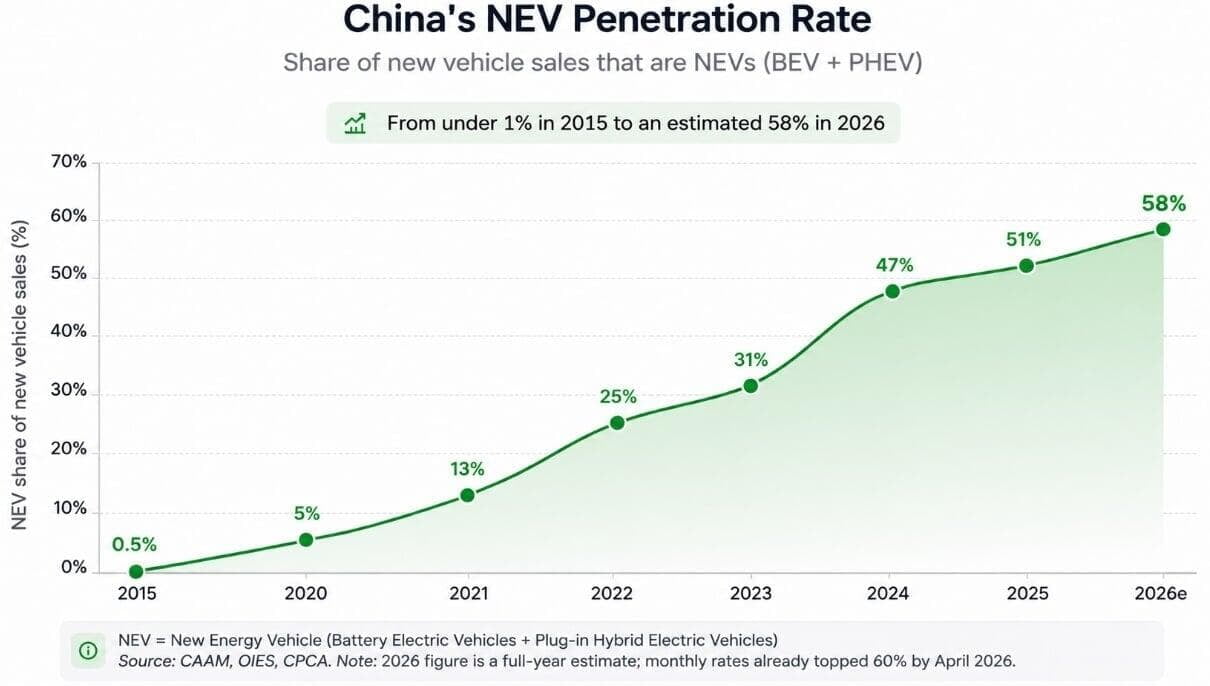
The more interesting part of China's story, for a venture investor, isn't the sales curve - it's where capital went after adoption accelerated:
- Charging infrastructure scaled to a scale with no real precedent. China's total charging infrastructure (public and private combined) crossed 21 million points by February 2026, growing roughly 48% year-on-year, of which public charging accounts for about 4.8 million. China now holds around 65% of global public EV charging capacity.
- Battery swapping became genuine infrastructure, not a niche idea.che idea.che idea. NIO alone operates more than 1,000 highway swap stations and has completed over 100 million battery swaps since its first station opened.
- Battery- and grid-storage-adjacent markets scaled into the hundreds of billions of dollars. China's broader energy storage market - batteries, pumped hydro, and thermal storage combined - grew from roughly $170bn in 2024 toward a projected $680bn+ by 2032. Narrower "grid-scale battery only" trackers put the market an order of magnitude lower (~$15-20bn in 2024), so the two aren't interchangeable - but by either measure, this is now a serious capital category, not an adjacent one.
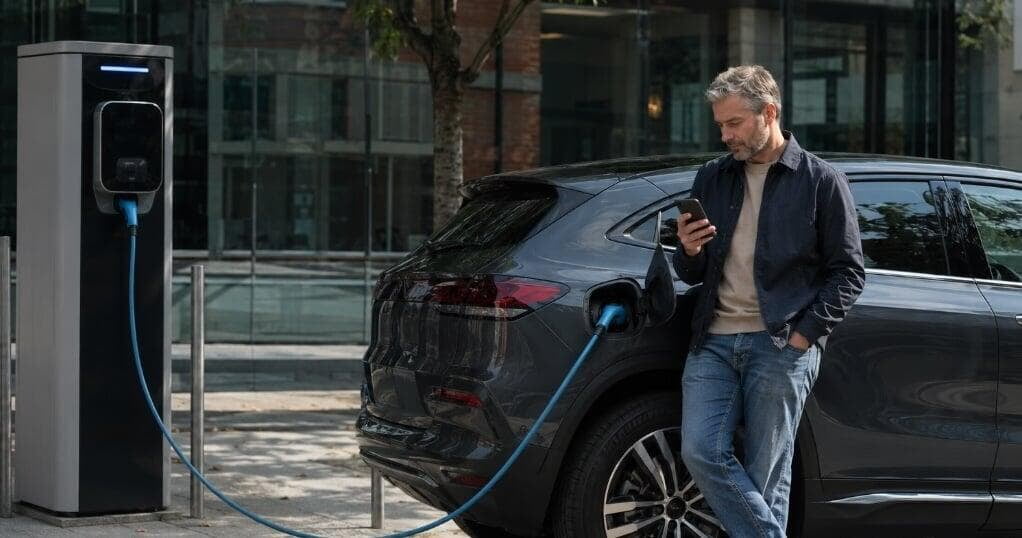
China vs. Delhi: EV Policy Approaches
1. Purchase subsidies- China: OEM + buyer subsidies
- Delhi: Road tax + registration fee exemption
2. Infrastructure mandated upfront- China: Infrastructure followed sales, years behind
- Delhi: ₹1,000 Cr earmarked; mandatory dealership installs from day one
3. Hard ICE phase-out (registration bans)- China: No national ban; city-level plate quotas favor NEVs, but market/subsidy-led overall
- Delhi: E-3W from Jan 2027; E-2W from Apr 2028
4. Sequencing- China: Sales-led → infrastructure catch-up
- Delhi: Subsidy + mandate + phase-out concurrently
1. Purchase subsidies
- China: OEM + buyer subsidies
- Delhi: Road tax + registration fee exemption
2. Infrastructure mandated upfront
- China: Infrastructure followed sales, years behind
- Delhi: ₹1,000 Cr earmarked; mandatory dealership installs from day one
3. Hard ICE phase-out (registration bans)
- China: No national ban; city-level plate quotas favor NEVs, but market/subsidy-led overall
- Delhi: E-3W from Jan 2027; E-2W from Apr 2028
4. Sequencing
- China: Sales-led → infrastructure catch-up
- Delhi: Subsidy + mandate + phase-out concurrently
Where this points for capital
A few figures illustrate the scale of the bottleneck India is walking into, each checked against the latest available data rather than the original policy-adjacent estimates:
Public charging- Current gap: India has ~52,700 public charging stations, but roughly 1 in 5 is estimated to be non-operational at any given time.
- Future opportunity: ~1.32 million public stations could be needed by 2030 to support 30% EV penetration, creating a major opportunity in charging infrastructure, reliability and utilisation.
Battery recycling- Current gap: India currently recycles only ~1% of end-of-life lithium-ion batteries.
- Future opportunity: A formal circular battery economy could reach ~$3.5 billion by 2030, creating opportunities across collection, recycling and material recovery.
Battery swapping (2W/3W)- Current gap: Battery swapping remains early-stage relative to China, despite growing demand from 2W/3W fleets.
- Future opportunity: Smaller battery packs and commercial fleet economics could make swapping structurally attractive for 2W/3W mobility, supporting further network expansion.
EV financing- Current gap: India’s EV financing market is ~$2.4 billion, while underserved 2W/3W buyers face 5–14% higher loan rates, partly due to limited resale value.
- Future opportunity: The market is projected to reach ~$28.8 billion by 2031, implying a 51.6% CAGR, with institutional capital already entering.
Fleet management & telematics- Current gap: The ~$1.9 billion fleet-management software market remains largely hardware/GPS-compliance-led, rather than EV-specific.
- Future opportunity: As fleets electrify, the underbuilt EV layer - battery-health monitoring, charging optimization and range prediction - could become a significant software opportunity. The market is projected to reach ~$3.5 billion by 2031.
Grid-scale battery storage- Current gap: India had only ~0.8 GWh of installed BESS capacity as of late 2025, with deployment still largely tender-driven.
- Future opportunity: CEA projects 47 GW / 236 GWh of BESS demand by 2031–32, with VGF covering up to 40% of capex - pointing to a much larger deployment opportunity.
A few figures illustrate the scale of the bottleneck India is walking into, each checked against the latest available data rather than the original policy-adjacent estimates:
Public charging
- Current gap: India has ~52,700 public charging stations, but roughly 1 in 5 is estimated to be non-operational at any given time.
- Future opportunity: ~1.32 million public stations could be needed by 2030 to support 30% EV penetration, creating a major opportunity in charging infrastructure, reliability and utilisation.
Battery recycling
- Current gap: India currently recycles only ~1% of end-of-life lithium-ion batteries.
- Future opportunity: A formal circular battery economy could reach ~$3.5 billion by 2030, creating opportunities across collection, recycling and material recovery.
Battery swapping (2W/3W)
- Current gap: Battery swapping remains early-stage relative to China, despite growing demand from 2W/3W fleets.
- Future opportunity: Smaller battery packs and commercial fleet economics could make swapping structurally attractive for 2W/3W mobility, supporting further network expansion.
EV financing
- Current gap: India’s EV financing market is ~$2.4 billion, while underserved 2W/3W buyers face 5–14% higher loan rates, partly due to limited resale value.
- Future opportunity: The market is projected to reach ~$28.8 billion by 2031, implying a 51.6% CAGR, with institutional capital already entering.
Fleet management & telematics
- Current gap: The ~$1.9 billion fleet-management software market remains largely hardware/GPS-compliance-led, rather than EV-specific.
- Future opportunity: As fleets electrify, the underbuilt EV layer - battery-health monitoring, charging optimization and range prediction - could become a significant software opportunity. The market is projected to reach ~$3.5 billion by 2031.
Grid-scale battery storage
- Current gap: India had only ~0.8 GWh of installed BESS capacity as of late 2025, with deployment still largely tender-driven.
- Future opportunity: CEA projects 47 GW / 236 GWh of BESS demand by 2031–32, with VGF covering up to 40% of capex - pointing to a much larger deployment opportunity.
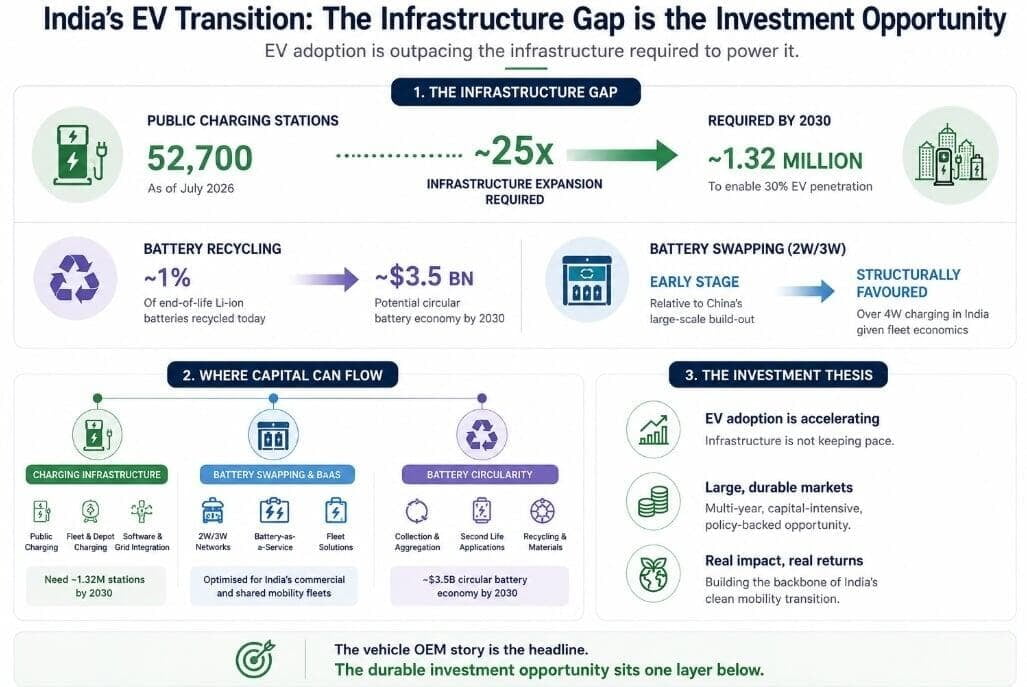
The pattern is consistent with the Battery Smart and Varaha thesis: the vehicle OEM story is the headline, but the durable investment opportunity sits one layer below, in the infrastructure the policy assumes will simply appear.
What could break the thesis
An honest read of the risks, since policy-driven infrastructure theses carry real execution risk that the top-line numbers don't show:
An honest read of the risks, since policy-driven infrastructure theses carry real execution risk that the top-line numbers don't show:
- Non-operational charger rates are high today- Roughly 1 in 5 installed public chargers in India isn't functioning at any given time, per the latest parliamentary data. Capital chasing charger count without underwriting uptime and utilisation is chasing the wrong metric.
- Delhi's policy is still a state-level intervention. The thesis depends on other large states following Delhi's template (as they historically have on EV policy), not on Delhi alone - that's a reasonable base rate, not a certainty.
- China's own experience is a distribution problem, not a shortage.China's car-to-charger ratio is ~2:1 overall, but ~10:1 for public chargers as private chargers dominate growth. Operators still earn just ¥0.04/kWh, with urban clustering leaving rural areas and highways underserved. The lesson for Delhi: charger siting matters as much as charger count.
- Battery-swapping economics remain vehicle-standard-dependent. Unlike Delhi's charging mandates, swapping only scales cleanly where battery form factors are standardised across OEMs - a coordination problem India hasn't fully solved.
- Non-operational charger rates are high today- Roughly 1 in 5 installed public chargers in India isn't functioning at any given time, per the latest parliamentary data. Capital chasing charger count without underwriting uptime and utilisation is chasing the wrong metric.
- Delhi's policy is still a state-level intervention. The thesis depends on other large states following Delhi's template (as they historically have on EV policy), not on Delhi alone - that's a reasonable base rate, not a certainty.
- China's own experience is a distribution problem, not a shortage.China's car-to-charger ratio is ~2:1 overall, but ~10:1 for public chargers as private chargers dominate growth. Operators still earn just ¥0.04/kWh, with urban clustering leaving rural areas and highways underserved. The lesson for Delhi: charger siting matters as much as charger count.
- Battery-swapping economics remain vehicle-standard-dependent. Unlike Delhi's charging mandates, swapping only scales cleanly where battery form factors are standardised across OEMs - a coordination problem India hasn't fully solved.
